|   |
4 June 1893 - Born Witham, Essex,
England
28 June 1911 - Volunteered for 12
years service, aged 18. Height 5'5", chest 34", Brown Hair, Blue Eyes, Fair Complexion.
I
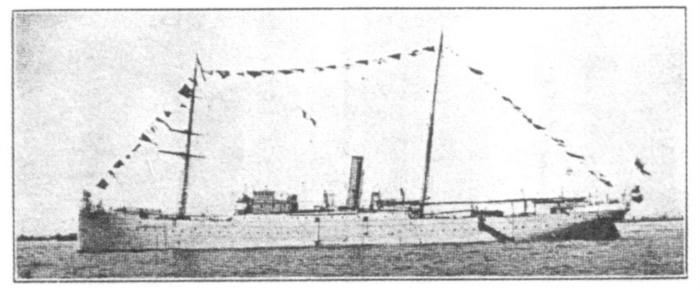
13 June 1914- 30 April 1915 - HMS Tyne, Destroyer Depot Ship, Sheerness, England.

HMS "Tyne".
1 May 1915 - 2 June 1915 - HMS Dolphin, shore
base, Chatham, England.
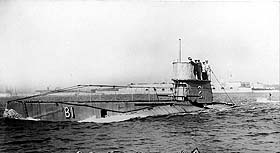
2 June 1915 - 1 November 1915 - HMS Dolphin, Assigned to Submarine "B-1" ex "Viper" which was commissioned on 18 October 1907 and sold for breaking in May 1921.

Submarine "B1".
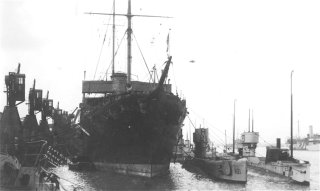
2 November 1915 - 6 January 1916 - HMS Maidstone,

HMS "Maidstone".
7 January 1916 - 20 March 1916 - HMS Dolphin,
21 March 1916 - 13 September 1916 - HMS Titania, shore
base, Chatham, England

HMS "Titania".
14 September 1916 - 24 March 1919 - HMS Maidstone
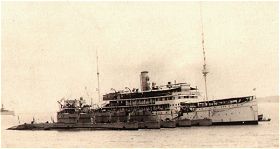
Signed on with Royal Australian Navy under Agreement for 3 years.

HMAS "Platypus".
25 March 1919 - 17 December 1921 - HMAS Platypus Rated Acting Leading Stoker for the period 21 June 1921 - 8 April 1922
while serving with the Royal Australian Navy.
HMAS Platypus left Portsmouth on 9 April 1919, escorting six "J" class submarines being sent out to Australia to set up the
RAN’s Second Submarine Flotilla.
In December, 1918, the Navy advised that six "J" class submarines were to be given to the Royal Australian Navy and volunteers
were called from the existing crews to serve for a 2, 3, or 5 year period, with the promise of immediate 28 days leave and
Australian rates of pay. Albert volunteered for a three-year period and was accepted.The J boats were commissioned into the
R.A.N. in March 1919.
The whole flotilla then moved to Vickers yard at Barrow-in-Furness to have refrigeration fitted in place of the beam
torpedo tubes. This however, was never done. Stanchions however, were fitted to carry a hawser around the boat to prevent
fellows being washed overboard, and on the stern was erected a standard to carry a hawser from the bridge that would carry
an awning to protect the deck from the intense heat of the tropical sun.
When this work was finished the ships proceeded to the Royal Naval Dockyard at Portsmouth and eventually on April 9th, 1919, set
set off for Australia, under Captain 'S', Captain Edward Courtenay (Paddy) Boyle, VC, as part of an Australian Fleet,
consisting of HMAS Australia (Battle cruiser) and three cruisers, Sydney, Melbourne, and Brisbane, plus six destroyers of
the River class, Paramatta, etc., and the submarine parent ship Platypus and her brood of six J boats.
The fleet eventually arrived in Sydney after a leisurely trip of three months, stopping at Gibraltar, Malta, Suez, Aden,
Columbo, Singapore, through the Timor Sea and the Torres Straight via Thursday Islands, then down through the Great Barrier
Reef to Brisbane, and then finally to Sydney.
It took such a long time because, after leaving Aden,a main propeller shaft broke and on reaching Colombo waited there
for a month while a new shaft was freighted from England.
They arrived in Sydney in July 1919 and being found
in poor condition were immediately placed in refit.
In 1920 after extensive work, five boats sailed from Sydney to the new submarine base at Geelong, Victoria. The depot ship
Platypus and the turret ship HMAS Cerberus were moored there also for support.
18 December 1921 - 8 April 1922 - HMAS London Depot,
9 April 1922 - 29 January 1923 - HMS Pembroke II, shore
base, Chatham.
30 January 1923 - 17 February 1923 - HMS Hecla,
destroyer depot ship (ex-"British Crown", launched 1878, 6,400 tons, 4-12 pdr
guns. Originally torpedo depot ship and played important role in developing
British torpedo forces).
18 February 1925 - 17 March 1926 - HMS Pembroke II,
To Royal Navy Hospital Chatham 17 February 1926. Invalided from service with
duodenal ulcer.
Return to Royal Navy Page
Return to Armed Forces Page
|